

When a company enters the Corporate Insolvency Resolution Process (CIRP),…
Read More
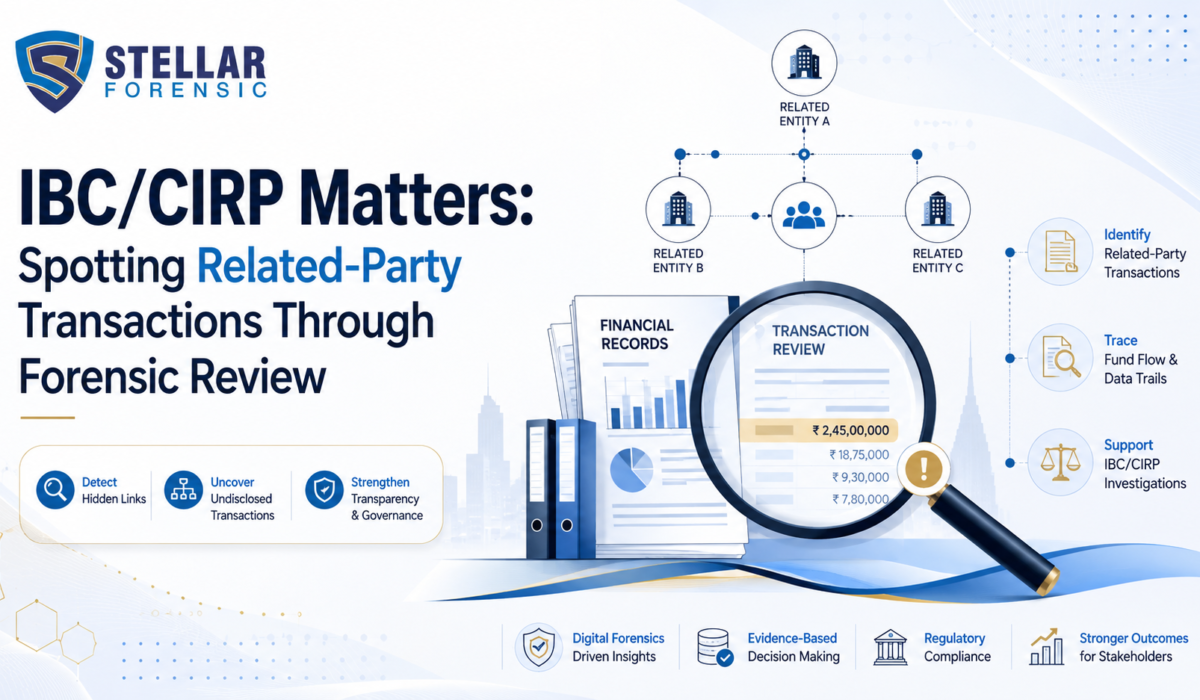
When a company enters the Corporate Insolvency Resolution Process (CIRP), the Resolution Professional’s mandate includes reviewing the corporate debtor’s transaction history for anything that improperly benefited insiders at the cost of creditors. On paper, this sounds straightforward. In practice, related-party transactions are rarely labeled as such; they are structured, layered, and often buried inside routine-looking entries that pass a surface-level audit without raising a flag.
This is where forensic review becomes essential, not as a compliance formality, but as the mechanism that actually finds what the transaction records were designed to hide.
Related-party transactions under the Insolvency and Bankruptcy Code (IBC) aren’t always structured through obviously connected entities. Promoters and insiders who anticipate scrutiny typically avoid direct related-party labeling by routing transactions through:
A standard accounting review, working off the books as declared, often cannot see past these structures. Forensic review works differently; it reconstructs the actual flow of funds and relationships, independent of how the transaction was labeled or disclosed.
Forensic review directly supports the Resolution Professional’s obligations under several critical IBC sections:
Section 43 Preferential Transactions: Transactions that put a related party in a more beneficial position than they would have received in a normal liquidation waterfall, made within the lookback period, need to be identified and reported to the Adjudicating Authority. Forensic reconstruction of transaction timing and beneficiary relationships is often the only way to establish the preferential nature of a transaction that appears unremarkable on its face.
Section 45 Undervalued Transactions: Assets or value transferred at below fair market value require forensic valuation analysis layered with document review to establish that the corporate debtor received significantly less than it gave up and that the counterparty was positioned to benefit from that gap.
Section 49 Transactions Defrauding Creditors: Where a transaction was structured specifically to put assets beyond the reach of creditors or to prejudice their interests, forensic review needs to establish intent through a pattern of behavior — timing relative to financial distress, communication trails, and structuring choices that indicate deliberate design rather than ordinary business activity.
Section 50 Extortionate Credit Transactions: Where the corporate debtor received credit on terms that required grossly exorbitant payments, or terms that otherwise unfairly disadvantaged it, the transaction can be examined and reversed by the Adjudicating Authority. Forensic review here focuses on comparing the actual commercial terms of the lending arrangement against market-standard terms, and tracing whether the lender was a related or connected party using the same relationship-mapping techniques applied to preferential and undervalued transactions.
Section 66 Fraudulent Trading / Wrongful Trading: Perhaps the most forensically intensive of the four, Section 66 requires establishing that business was conducted with intent to defraud creditors, or that directors continued trading despite knowing insolvency was unavoidable. This typically requires reconstructing board-level knowledge, internal communications, and financial decision-making timelines well beyond what standard financial statements reveal.
1. Round-tripping patterns. Funds that leave the corporate debtor and return through a different route, often with a time gap and a change in transaction characterization (e.g., an “advance” that comes back as a “loan repayment” from an unrelated-looking entity).
2. Structuring below reporting or approval thresholds. Multiple transactions kept just under board-approval or audit-flagging thresholds, split deliberately to avoid scrutiny a classic structuring pattern that forensic transaction analysis is specifically designed to detect.
3. Pre-insolvency outflow acceleration. A noticeable increase in payments, asset transfers, or fund movement to specific counterparties in the months immediately preceding the insolvency commencement date (ICD) is often the clearest forensic signal of anticipated distress.
4. Common addresses, contact details, or digital footprints. Vendor or counterparty entities that share registered addresses, phone numbers, email domains, or even IP addresses used for transaction approvals with the corporate debtor or its promoters — connections that don’t appear in formal related-party disclosures but surface clearly under digital forensic review.
For a Resolution Professional, correctly identifying related-party transactions has direct consequences:
A forensic report that traces fund flow, establishes beneficiary relationships, and reconstructs transaction timelines gives the Resolution Professional and the Committee of Creditors a defensible basis for these decisions, one that can withstand challenge in NCLT proceedings.
1. Engage forensic review early in the CIRP timeline, not only when a specific transaction is already under suspicion. Early engagement allows time to reconstruct multi-year transaction histories within the resolution timeline.
2. Go beyond the books. Bank statement analysis, digital device review, and communication forensics together build a picture that financial statements alone cannot provide.
3. Cross-reference registered related-party disclosures against independently discovered relationships. The gap between what was disclosed and what forensic review uncovers is often where the most significant findings emerge.
4. Document findings to BSA 2023 evidentiary standards. Any transaction analysis intended to support action before the NCLT needs to be collected, preserved, and certified in a manner that satisfies electronic evidence admissibility requirements under the Bharatiya Sakshya Adhiniyam, 2023.
Related-party transactions in a distressed company are rarely disclosed as such; they are structured to look ordinary. A forensic review doesn’t take the transaction register at face value; it reconstructs the actual relationships and fund flows behind it. For Resolution Professionals navigating Sections 43, 45, 49, and 66, that reconstruction is often what separates a resolution plan that withstands NCLT scrutiny from one that doesn’t.
Stellar Forensic supports Resolution Professionals, insolvency practitioners, and Committees of Creditors with forensic transaction analysis, bank statement forensics, and evidence reporting for IBC/CIRP matters under BSA 2023 requirements. To discuss a forensic review for an ongoing CIRP matter, reach out at info@stellarforensic.in.
When a company enters the Corporate Insolvency Resolution Process (CIRP),…
Read More
Every corporate governance framework in India leans on the same…
Read More
In an increasingly complex global marketplace, middle-market enterprises and Small-to-Medium…
Read More
When you enter a merger or acquisition, you are not…
Read More
Introduction Your smartphone knows more about you than almost anyone…
Read More
A cyber-attack does not end when the attacker leaves. In…
Read More
Understanding the Practical Challenges of Digital Evidence Certification In contemporary…
Read More
What Are Insider Threats? Definition and Types Insider threats are…
Read More
India’s digital ecosystem has crossed a point of no return.…
Read More
In today’s digital-first business environment, social media is both a…
Read More